
Building a website in 2026 is not only about buying a domain, choosing a template, and publishing a few pages. A modern website needs strong design, fast loading speed, mobile responsiveness, SEO structure, secure hosting, clear content, and a smooth path that turns visitors into leads or customers.
That is why the real website cost depends on your goal, platform, design quality, development scope, content, integrations, SEO cost, and long-term website maintenance cost. A simple portfolio website may cost a few hundred dollars, while a custom Webflow website, business website, SaaS website, or eCommerce store can move into thousands.
Many website projects fall between $300 and $5,000, but that number should be treated as a planning range, not a fixed quote. Upwork's 2026 guide lists personal blogs at $300 to $800, portfolio sites at $500 to $2,000, eCommerce sites at $1,000 to $5,000+, corporate sites at $1,500 to $4,000+, and news or media sites at $2,000 to $5,000+.
Quick Cost Snapshot
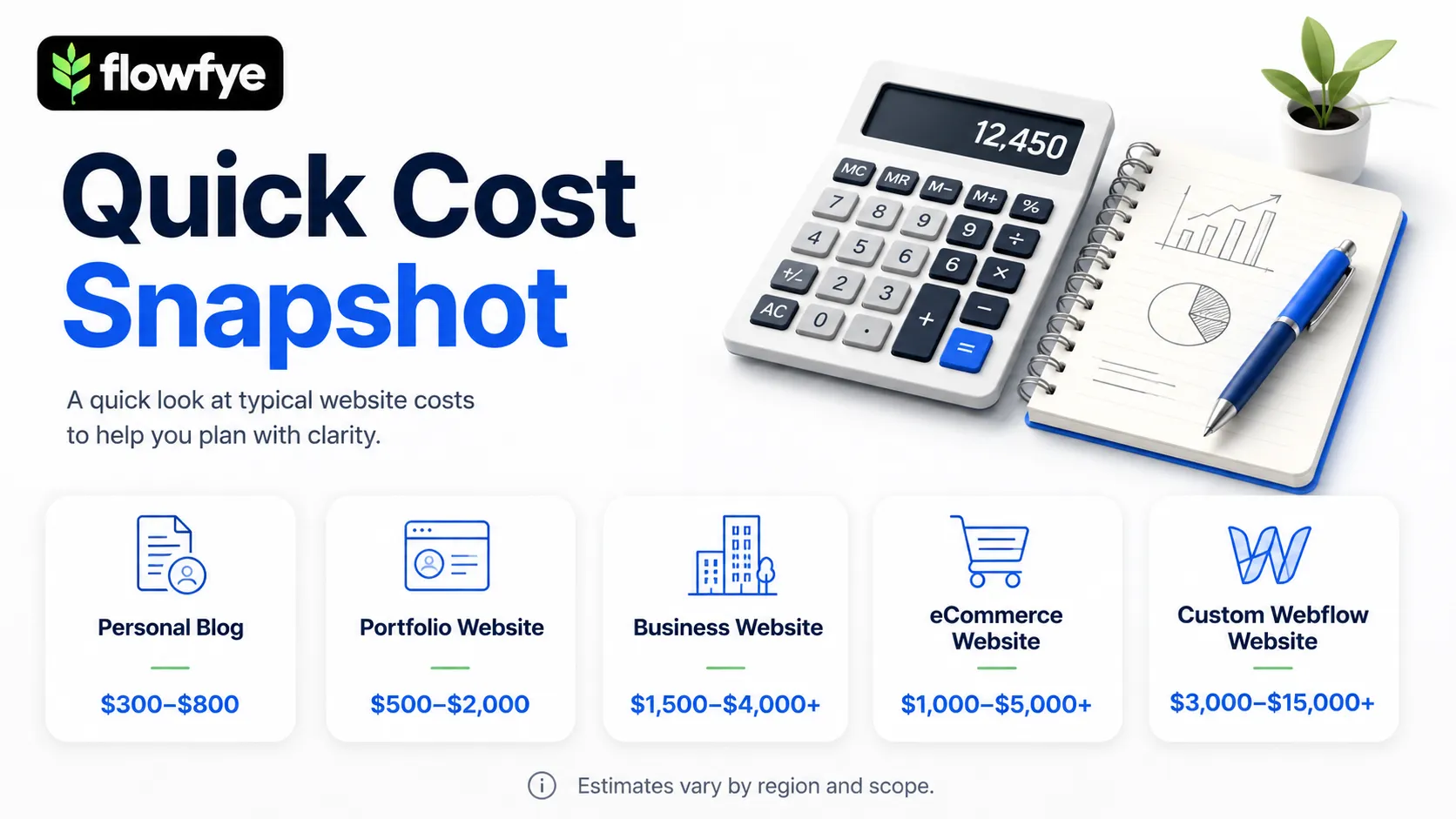
Here is a simple way to understand the cost of building a website:
- Personal blog: around $300 to $800
- Portfolio website: around $500 to $2,000
- Corporate or small business website: around $1,500 to $4,000+
- eCommerce website: around $1,000 to $5,000+
- News or media website: around $2,000 to $5,000+
- Custom Webflow website: often $3,000 to $15,000+, depending on scope
Pricing warning: Website pricing can vary by region, currency, tax, billing cycle, platform updates, developer skill, agency process, and support requirements. Always check official platform pricing before finalizing your budget.
What Affects Website Development Cost?
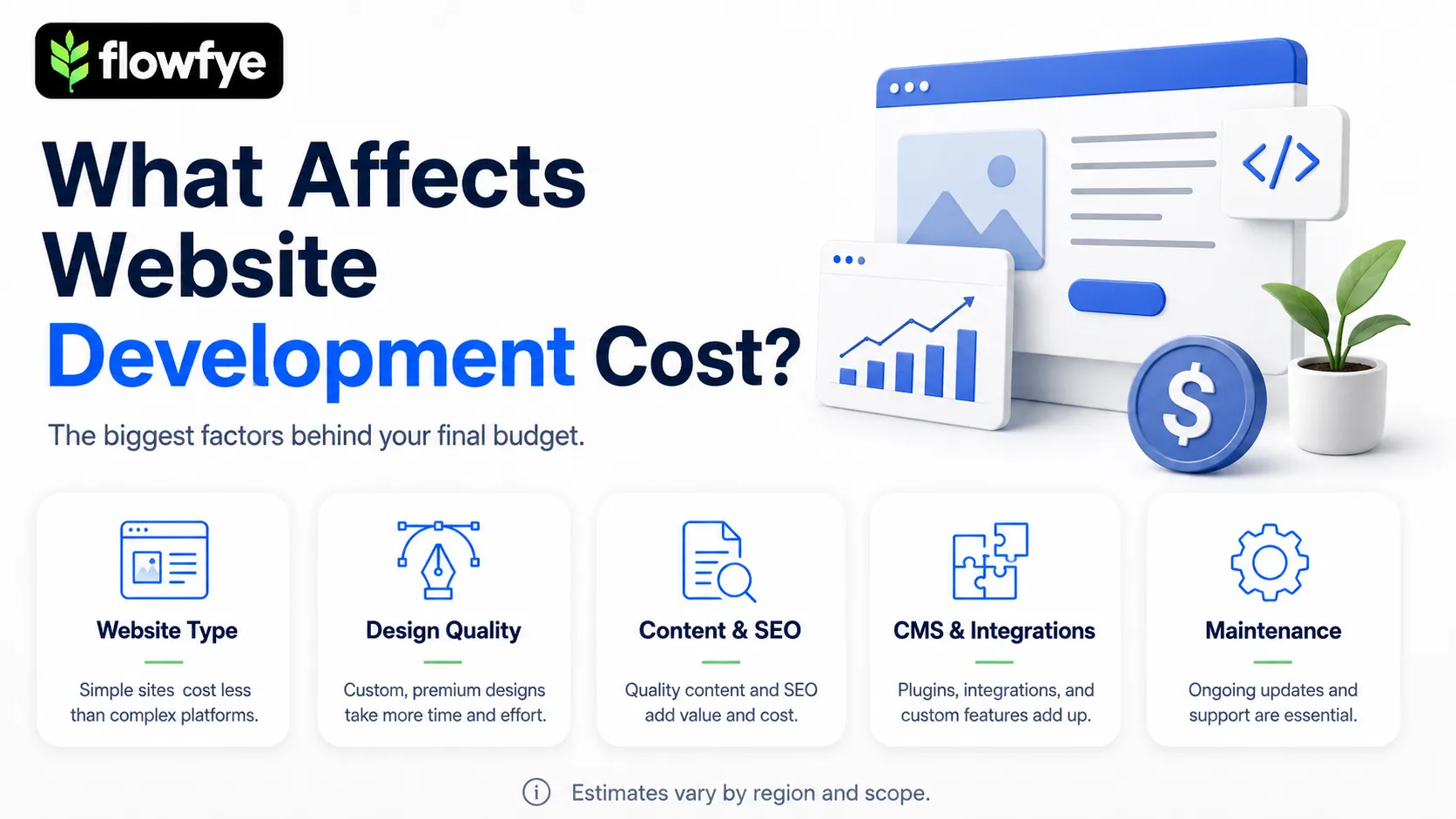
Website development cost is not based only on page count. A 5-page custom website can cost more than a 15-page template website if it needs original UI design, CMS setup, copywriting, interactions, integrations, and SEO planning.
Website Type and Business Goal
Different websites need different structures. A portfolio website may focus on case studies, testimonials, and contact forms. A SaaS website needs product sections, feature pages, pricing, comparison content, and conversion-focused CTAs. An eCommerce website needs product pages, cart, checkout, payment setup, shipping rules, and inventory logic.
The more your website supports real business operations, the more planning and development it needs.
Design Quality and Brand Experience
Website design cost depends on how much original design work is required. A template-based website is more affordable because the base layout already exists. A custom UI/UX design costs more because it includes layout planning, visual direction, responsive design, brand consistency, and user journey thinking.
Good design is not only about making the website look clean. It helps users understand your offer faster, trust your brand, and take action with less confusion.
Content, SEO, and Integrations
Many businesses only budget for design and development. Later, they realize they still need headlines, service copy, product descriptions, blog content, FAQs, meta titles, meta descriptions, image alt text, and internal links.
A basic website may only need a contact form and analytics. A more advanced website may need CRM integration, booking tools, payment gateway, email marketing, live chat, automation, member access, or API connections. These features increase web developer cost because they need setup, testing, troubleshooting, and sometimes ongoing support.
Webflow Website Cost in 2026

Webflow website cost has two parts. The first is Webflow's platform cost. The second is the cost of design, development, template customization, CMS setup, SEO, and launch support.
Webflow's current pricing page lists Starter, Basic, Premium, Team, and Enterprise site plans. Basic is listed at $15 per month when billed yearly, Premium at $25 per month when billed yearly, Team at $2,500 per month with an annual contract, and Enterprise uses custom pricing. Webflow also notes that prices are in USD per site, with applicable taxes added at checkout.
Webflow also updated its pricing and packaging in May 2026. The update simplified Site plans, introduced the Team plan, added AI credits to Workspace plans, and combined older CMS and Business Site plans into the newer Premium Site plan for new purchases.
When Webflow Is Cost-Effective
Webflow is cost-effective when your business needs strong visual design, CMS flexibility, landing pages, fast marketing updates, and fewer plugin-related maintenance issues. For startups, agencies, SaaS brands, and service businesses, Webflow gives more design control than many basic website builders.
A Webflow template can reduce upfront website cost because the design foundation is already ready. Instead of starting from zero, you can customize a professional template with your own brand, content, sections, CMS, and SEO setup.
When Webflow Can Cost More
Webflow cost can increase when you need custom UI design, complex CMS collections, advanced animations, custom code, third-party integrations, SEO migration, or ongoing optimization.
So, the better question is not only how much Webflow costs monthly. The better question is how much value your Webflow website needs to deliver for your business.
WordPress Website Cost in 2026
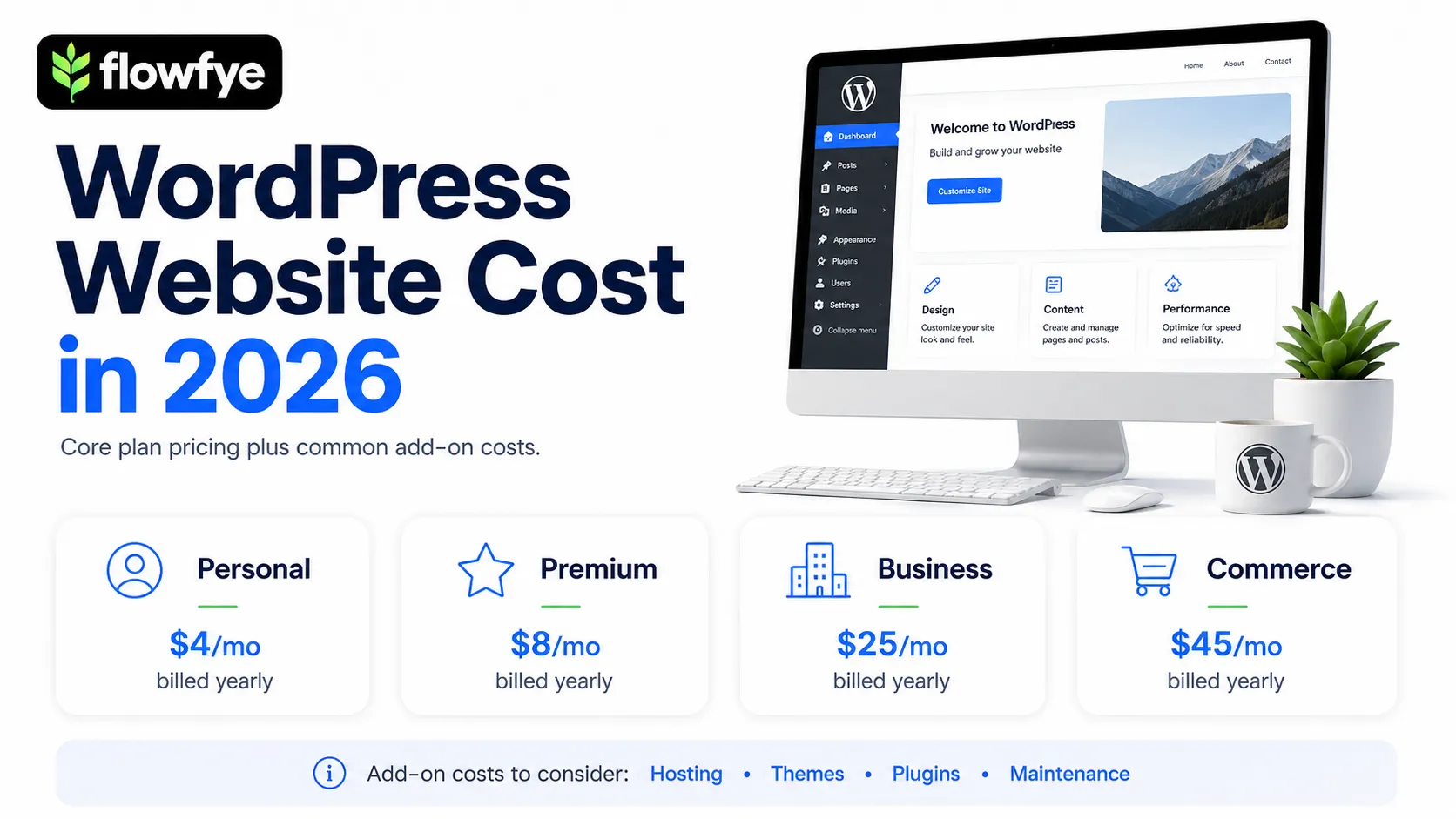
WordPress website cost depends on whether you use WordPress.com or self-hosted WordPress. WordPress.com pricing currently shows Personal at $4 per month when billed yearly, Premium at $8 per month when billed yearly, Business at $25 per month when billed yearly, and Commerce at $45 per month when billed yearly. Monthly prices are higher.
WordPress can be affordable at the start, especially for blogs and content-heavy websites. But the full cost may increase when you add hosting, premium themes, paid plugins, security tools, backup tools, speed optimization, and developer support.
Webflow vs WordPress Cost
Webflow vs WordPress cost should not be judged only by monthly pricing. WordPress can be powerful and flexible, especially for blogs, content platforms, and plugin-based websites. But plugin-heavy WordPress sites often need more technical care over time.
Webflow can be better for businesses that want custom design, visual control, marketing flexibility, and less plugin maintenance. The right choice depends on your website goal, content structure, technical needs, and maintenance preference.
Website Builder Cost: Wix, Shopify, and Other Platforms

Website builder cost is usually easier to understand because many platforms include hosting, templates, SSL, and basic website tools in one subscription.
Wix can work well for simple DIY websites, especially when users need quick setup and basic pages. Its pricing page shows a free plan and paid plans, but it also clearly says prices and currency vary by location, displayed prices are for yearly subscriptions, and final pricing depends on checkout details.
Shopify is usually stronger for serious eCommerce websites because it is built around products, checkout, inventory, payments, and selling across channels. Shopify includes secure commerce hosting, unlimited bandwidth, and a free TLS or SSL certificate for domains added to Shopify.
Which Platform Should You Choose?
- Choose Wix for a simple DIY website.
- Choose Shopify for a product-focused online store.
- Choose WordPress for a flexible blog or content-heavy website.
- Choose Webflow for a custom marketing website, CMS, landing pages, and cleaner visual development.
Domain Cost, Hosting Cost, and SSL Certificate Cost

Domain cost is usually paid yearly. A common planning range is around $10 to $20 per year, although the final price depends on the domain extension, registrar, renewal rate, privacy protection, and whether the domain is premium.
Hosting cost depends on the platform. Webflow, Wix, Shopify, and WordPress.com usually include hosting inside their paid plans. Self-hosted WordPress and custom-coded websites usually need separate hosting.
For planning, Upwork lists shared hosting around $2.50 to $5 per month, VPS hosting around $20 to $100 per month, dedicated hosting around $100 to $250+ per month, and cloud hosting around $40 to $500+ per month for 2025 to 2026 averages.
SSL certificate cost is often zero because many platforms include SSL by default. Let's Encrypt also provides free TLS certificates, which is why many hosting providers can offer free SSL for normal websites.
Website Design Cost and Web Developer Cost
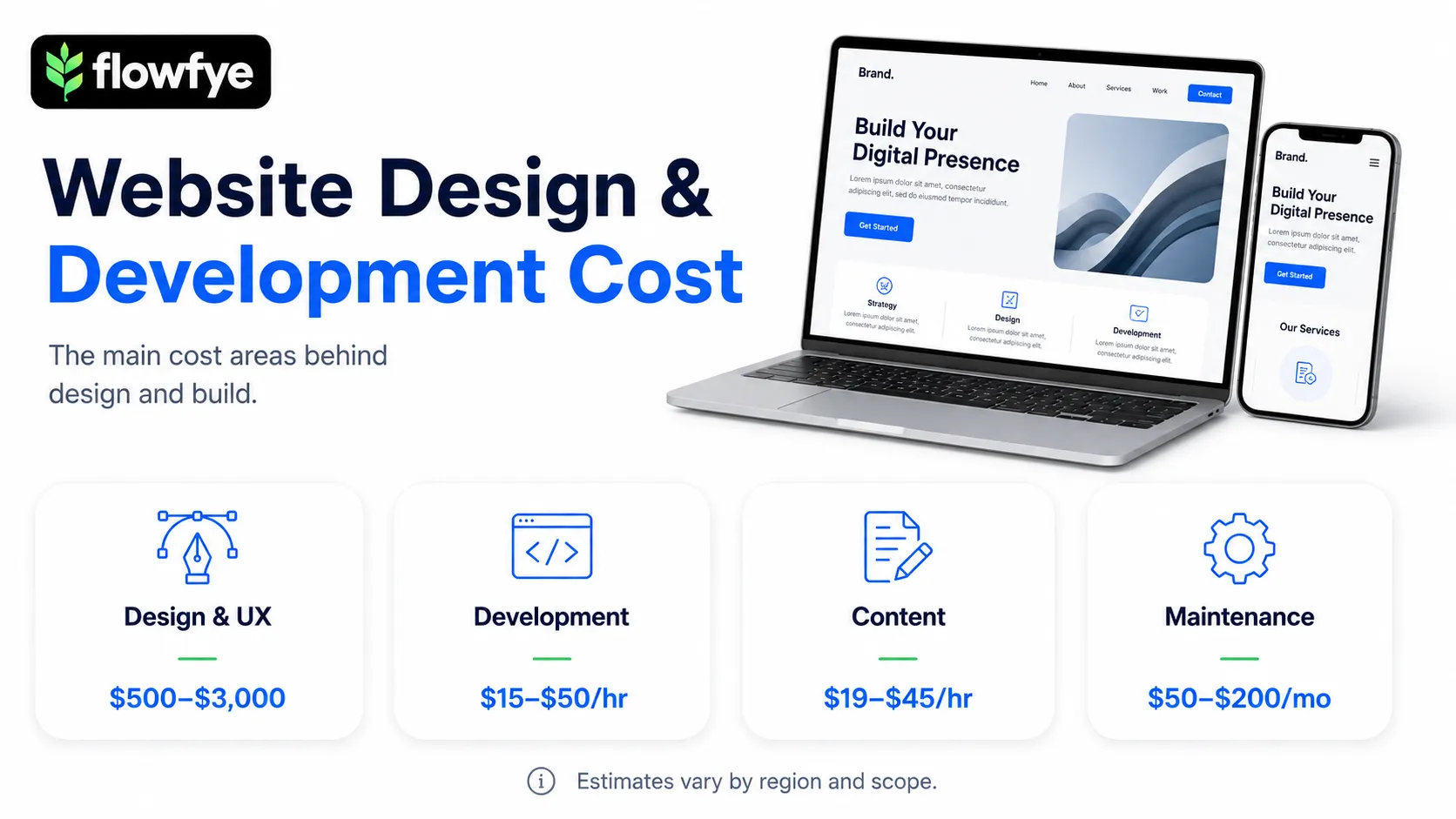
Website design cost depends on how much design thinking your website needs. A basic template edit may only need layout changes, colors, typography, image updates, and responsive fixes. A serious business website may need UX planning, wireframes, custom visuals, conversion sections, and responsive design.
Web developer cost also depends on experience, location, and complexity. Upwork lists web developers on its platform at $15 to $50 per hour as median hourly rates, while its hourly breakdown shows entry-level developers around $15 to $25 per hour, intermediate developers around $30 to $50 per hour, and experts around $50 to $200 per hour.
A lower hourly rate does not always mean lower total cost. An experienced developer may charge more per hour, but they can often build faster, avoid technical mistakes, and create a cleaner structure that saves money later.
eCommerce Website Cost

eCommerce website cost is usually higher than a normal business website because an online store has more moving parts. A basic eCommerce website may need product pages, category pages, cart, checkout, payment gateway, shipping settings, tax settings, and email notifications.
A more advanced store may also need product filters, inventory logic, abandoned cart recovery, reviews, upsells, analytics, and conversion tracking. The cost also depends on product count, app setup, payment methods, and design quality.
Shopify is often the practical choice for product-heavy stores. Webflow can work well for brand-first stores, small catalogs, digital products, and marketing-led commerce experiences.
Website Maintenance Cost
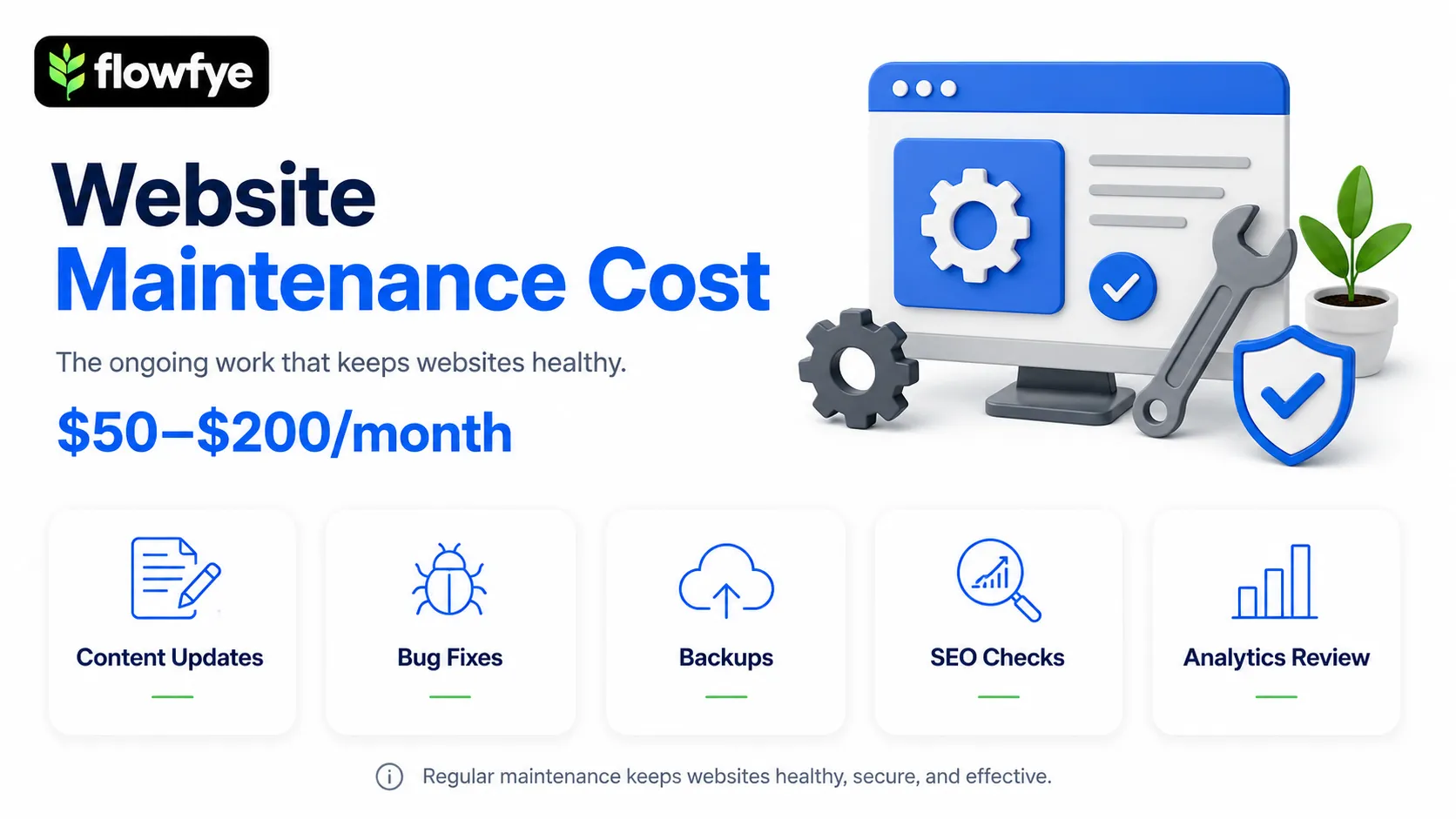
Website maintenance cost keeps your website healthy after launch. This includes content updates, small design changes, form checks, bug fixes, speed reviews, SEO checks, analytics review, and security monitoring.
Common maintenance tasks include:
- Updating website content and CMS items
- Fixing broken links or form issues
- Reviewing speed and mobile performance
- Checking SEO metadata and indexing
- Improving conversion sections over time
Upwork lists maintenance and security around $50 to $200 per month as an average 2026 cost area. It also lists marketing and SEO tools around $100 to $500 per month, depending on the project setup.
Webflow websites usually need less plugin-related maintenance than WordPress websites. But every serious business website still needs regular content updates, SEO improvements, and conversion optimization.
SEO Cost and Website Redesign Cost
SEO cost depends on your industry, competition, and growth goal. A basic website may only need technical SEO setup, title tags, meta descriptions, heading structure, image alt text, sitemap, indexing setup, and Google Search Console.
A growth-focused website may need keyword research, blog strategy, internal linking, schema markup, content writing, conversion tracking, and monthly reporting. SEO should not be treated as an afterthought because fixing structure, URLs, metadata, and content hierarchy later can create extra cost.
Website redesign cost depends on how much of the old website needs to change. A light redesign may only include visual improvements, spacing fixes, typography updates, and mobile layout improvements. A full redesign may include new UX structure, copywriting, CMS rebuild, SEO migration, platform migration, animations, and performance optimization.
Simple Website Cost Calculator
A useful website cost calculator should include more than design and development.
Total website cost = platform cost + domain + hosting + design + development + content + SEO + integrations + maintenance
For a small business website, your budget may include:
- Domain registration
- Webflow, WordPress, Wix, or Shopify plan
- Template or custom design
- Web development and CMS setup
- Copywriting and SEO setup
- Analytics, launch support, and monthly optimization
This gives a more realistic budget than only asking how much does it cost to create a website.
How to Reduce Website Development Cost Without Hurting Quality
The best way to reduce website development cost is not to choose the cheapest option. The better approach is to reduce unnecessary work.
Start with a clear website goal, prepare your content early, choose the right platform, keep the first version focused, and avoid features you do not need at launch. A premium Webflow template can also reduce cost because the foundation is already designed.
For many startups and small businesses, a Webflow template with expert customization gives a strong balance between quality, speed, and budget.
When Should You Hire a Webflow Developer?
You should hire Webflow developer support when your website needs more than basic template editing. A Webflow expert can help with CMS setup, custom layouts, animations, responsive fixes, SEO setup, website migration, and launch support.
If you compare Webflow agency pricing, remember that you are not only paying for pages. You are paying for planning, structure, design quality, clean development, testing, SEO setup, and long-term scalability.
A Smarter Way to Control Website Cost with Flowfye

The best way to control website cost is to choose the right starting point. Not every business needs a fully custom website from day one, but every business needs a website that looks professional and supports growth.
Flowfye helps startups, agencies, SaaS brands, service businesses, and growing companies build better websites with a practical approach. Instead of starting every project from zero, you can begin with a premium Webflow template, customize it for your brand, and launch faster with a professional structure already in place.
This is useful when you want a modern Webflow website without a full custom budget, faster launch time, template customization based on your content, CMS setup for blogs or case studies, or custom Webflow development when the project needs more flexibility.
Final Thoughts: What Should Your Website Budget Be?
There is no fixed answer to how much a website costs in 2026. A basic website may cost a few hundred dollars. A professional business website may cost a few thousand. A custom Webflow, SaaS, or eCommerce website can cost much more depending on strategy, design, CMS, SEO, integrations, and maintenance.
The best website budget is not the lowest budget. It is the budget that gives your business the right balance of design quality, speed, SEO, scalability, and conversion potential.
If you want to launch faster, control cost, and still keep a premium website experience, Flowfye can help you choose between a Webflow template, template customization, or a custom Webflow build based on your budget and growth goal.

